
Seville Cathedral (Catedral de Santa María de la Sede) is one of those rare buildings that genuinely exceeds expectations. Even visitors who have seen great Gothic cathedrals elsewhere are stopped in their tracks by the scale of its interior, the weight of its history, and the extraordinary collection of art and architecture contained within its walls.
Built on the site of a 12th-century Almohad mosque — whose minaret still stands today as the Giralda — the cathedral was conceived with deliberate ambition. According to historical records, the cathedral chapter declared their intention to build something so magnificent that future generations would think them mad. They very nearly succeeded.
This page covers everything worth seeing inside Seville Cathedral, from the highlights you should not miss to practical information for your visit.
Book your tickets
Seville Cathedral is one of Spain’s most visited monuments and entry slots fill up quickly. Booking online means you go straight in through the dedicated entrance at the Puerta del Lagarto — no queuing at the door.
The largest Gothic cathedral in the world
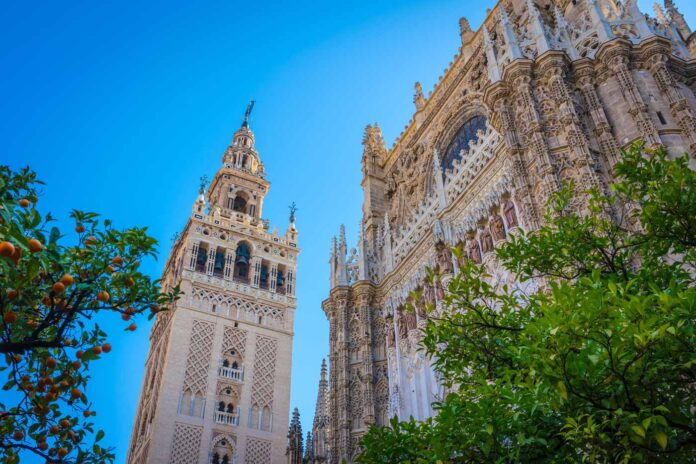
Construction began in 1401 on the footprint of the former great mosque of Seville. The ambition was clear from the outset: this was not merely a place of worship but a statement of reconquered Christian Seville, a monument to faith, power, and permanence. Work continued for over a century, with the main structure largely complete by 1506.
What makes Seville Cathedral architecturally exceptional is not just its size — though it is the largest Gothic cathedral in the world — but the layers of history embedded in its structure. Moorish, Gothic, Renaissance, and Baroque elements coexist within the same complex, reflecting seven centuries of continuous use, renovation, and expansion.
The result is a building that feels alive with accumulated history rather than frozen in a single moment.
What to see inside — the highlights
The Retablo Mayor — the main Altarpiece
The focal point of the entire cathedral, and one of the most extraordinary objects in Spain. The main altarpiece is the largest wooden altarpiece in the world, crafted over nearly a century by Spanish and Flemish artists. Its 44 relief panels and over 200 statues vividly depict scenes from the life of Christ and the Virgin Mary. The sheer scale of the gilded structure, rising to the full height of the cathedral’s central nave, is breathtaking. Allow time to stand before it and take in the detail.
The tomb of Christopher Columbus
One of the most photographed objects in the cathedral, and one of the most debated in all of Spain. The tomb of Christopher Columbus is carried by four statues representing the medieval kingdoms of Spain, symbolizing the nation’s unity during Columbus’s voyages. The design was completed in the 19th century. Whether or not Columbus’s remains are truly buried here — a question historians continue to debate — the monument is a powerful and moving piece of funerary sculpture.
The Giralda tower
Originally constructed as the minaret of the Almohad mosque in the 12th century, the Giralda is the most recognisable symbol of Seville. A Renaissance bell tower was added after the Reconquista, giving it the distinctive silhouette it has today. What makes it unique among bell towers is that you ascend via a series of ramps rather than stairs — wide enough that, according to legend, the muezzin once rode to the top on horseback. The views from the top across Seville’s historic centre are exceptional.
▶ Learn more about the Giralada tower
The Royal Chapel
The Royal Chapel is the spiritual and dynastic heart of the cathedral, housing the remains of King Ferdinand III of Castile — the king who reconquered Seville from the Moors in 1248 and was later canonised. Inside, visitors can admire the stunning 13th-century Gothic statue of the Virgin of the Kings, placed beneath an ornate silver canopy. The chapel is still used for religious services and retains an atmosphere of genuine sanctity.
The Patio de los Naranjos
Before entering the cathedral, most visitors pass through this serene courtyard. Once the courtyard of the mosque where worshippers performed ablutions before praying, it retains its original character and orange trees, which set it apart from any other courtyard in the city. It is one of the few surviving elements of the original Almohad complex and offers a peaceful contrast to the overwhelming scale of the cathedral interior.
The Choir
Positioned in the centre of the nave, the choir is a masterpiece of Renaissance woodcarving. The choir stalls feature 117 intricately carved wooden seats, with carvings believed to have been made between the 15th and 16th centuries. The choir is flanked by the two organs of the cathedral — one of which was rebuilt following earthquake damage in 1888, and both of which were restored in the late 20th century. Catalonia Hotels & Resorts
The Sacristy and Treasury
Often overlooked by visitors in a hurry, the Main Sacristy and the Treasury contain one of the richest collections of religious art in Spain. Paintings by Murillo, Zurbarán, and Goya hang alongside jewelled monstrances, elaborate vestments, and centuries of accumulated liturgical objects. The architecture of the Main Sacristy itself — a Renaissance domed chamber — is worth the detour.
Architecture — Five centuries in a single building
Seville Cathedral is architecturally unusual in that it does not belong to a single style or period. The Gothic structure of the nave and chapels dates primarily from the 15th century, but the Royal Chapel, Chapter House, and Main Sacristy are Renaissance additions from the 16th century. The Sagrario chapel is Baroque. The Giralda is Moorish at its base, Renaissance at its crown.
This layering of styles is not the result of inconsistency but of continuous history. Each generation added to the building according to the needs and tastes of its time. Walking through Seville Cathedral is, in a sense, walking through five centuries of Andalusian history in a single building.
Facts & Figures
- Total area: approximately 11,520 m²
- Length of the cathedral: 135 metres
- Width: 100 metres
- Height of the Giralda tower: 104 metres
- Number of chapels: 80
- Panels in the Retablo Mayor: 44 — the largest Gothic altarpiece in the world
1401
104 meters
0 stairs
1987
Practical information
How to get there?
No idea how to get there? Check out our full guide about how to get to the Seville Cathedral by foot or public transportation.
Cathedral entrances — Where to enter
Seville Cathedral has two main entrances for cultural visits, and using the correct one makes a real difference to your experience on arrival.
- Puerta del Lagarto (Door of the Lizard): Located on Calle Alemanes, on the north side of the cathedral. This is the entrance for visitors with pre-booked online tickets. The name comes from a stuffed crocodile — reputedly a gift from the Sultan of Egypt to King Alfonso X in the 13th century — which hangs in the adjacent vestibule and is one of the cathedral’s most curious curiosities. Head here if you have booked online and you will enter without joining the ticket queue.
- Puerta del Príncipe (Door of the Prince): Located on the south side of the cathedral facing Plaza del Triunfo. This is the entrance for visitors purchasing tickets on the day at the door. Queue times here can be significant during peak season, particularly on weekends and in summer.
If you have booked your ticket online, always go to the Puerta del Lagarto. It is faster and, as an added bonus, you get to see the crocodile.
Opening hours
| Day | Opening | Last Admission | Closing |
|---|---|---|---|
| Monday – Saturday | 11:00 | 18:00 | 19:00 |
| Sunday | 14:30 | 18:00 | 19:00 |
For full details on closures, public holidays, and free entry periods, visit our Opening Hours page.
Admission & tickets
| Area | Price | Tickets |
|---|---|---|
| Cathedral & Giralda | from 18.00 € | Tickets |
| Cathedral & Giralda (Guided tour) | from 23,00 € | Tickets |
| Cathedral & Giralda + Alcázar | from 44,50 € | Tickets |
| Cathedral & Giralda + Alcázar (Guided tour) | from 53,00 € | Tickets |
Tickets are available for several combinations, including the standard Cathedral + Giralda entry and combination tickets with the Royal Alcázar. Booking online in advance is strongly recommended. For full pricing and booking options, visit our Tickets & Prices page.
Dress Code
As an active place of worship, Seville Cathedral requires appropriate clothing. Shoulders and knees must be covered for both men and women. Sleeveless tops, shorts, and short skirts are not permitted. A light scarf or cover-up is recommended, particularly in summer. The dress code applies to all areas of the cathedral, including the Giralda tower.
How long does a visit take?
Allow a minimum of 75 minutes for a self-guided visit covering the cathedral interior and the Giralda tower. For a more detailed exploration including the chapels, Treasury, and Sacristy, plan for around two hours. Guided tours typically last 90 minutes.
Frequently Asked Questions (FAQ) about the Seville Cathedral
Why is Seville Cathedral so important?
Seville Cathedral is the largest Gothic cathedral in the world and a UNESCO World Heritage Site. Beyond its size, it holds extraordinary historical significance — it is the burial place of Christopher Columbus and several Castilian monarchs, and it stands on the site of one of the great mosques of medieval Andalusia. Few buildings in Europe carry this weight of history in a single structure.
Why is the Giralda tower so unusual?
The Giralda was originally built as the minaret of the Almohad mosque in the 12th century, making it over 800 years old. Unlike most bell towers, it has no stairs — the entire ascent is via a series of 35 ramps, reportedly designed so the sultan could ride to the top on horseback. The Renaissance bell tower added after the Reconquista gives it its distinctive silhouette.
Is Christopher Columbus really buried in Seville Cathedral?
This is one of the great debates of Spanish history. The cathedral holds a monumental tomb carrying remains attributed to Columbus, but their authenticity has been disputed for centuries — particularly given competing claims from the Dominican Republic. DNA analysis conducted in 2006 confirmed a partial match with known Columbus relatives, though the matter has never been fully resolved.
What is the Retablo Mayor?
The Retablo Mayor is the main altarpiece of Seville Cathedral and the largest Gothic altarpiece in the world. It took nearly a century to complete and features 44 carved relief panels and over 200 statues depicting scenes from the life of Christ and the Virgin Mary. It is entirely gilded and rises to the full height of the central nave.
What was on this site before the cathedral?
The cathedral was built on the site of the great Almohad mosque of Seville, constructed in the 12th century. When Seville was reconquered by Ferdinand III in 1248, the mosque was converted into a cathedral. A century later it was demolished to make way for the current Gothic structure — though the Giralda minaret and the Patio de los Naranjos courtyard were preserved and remain standing today.